
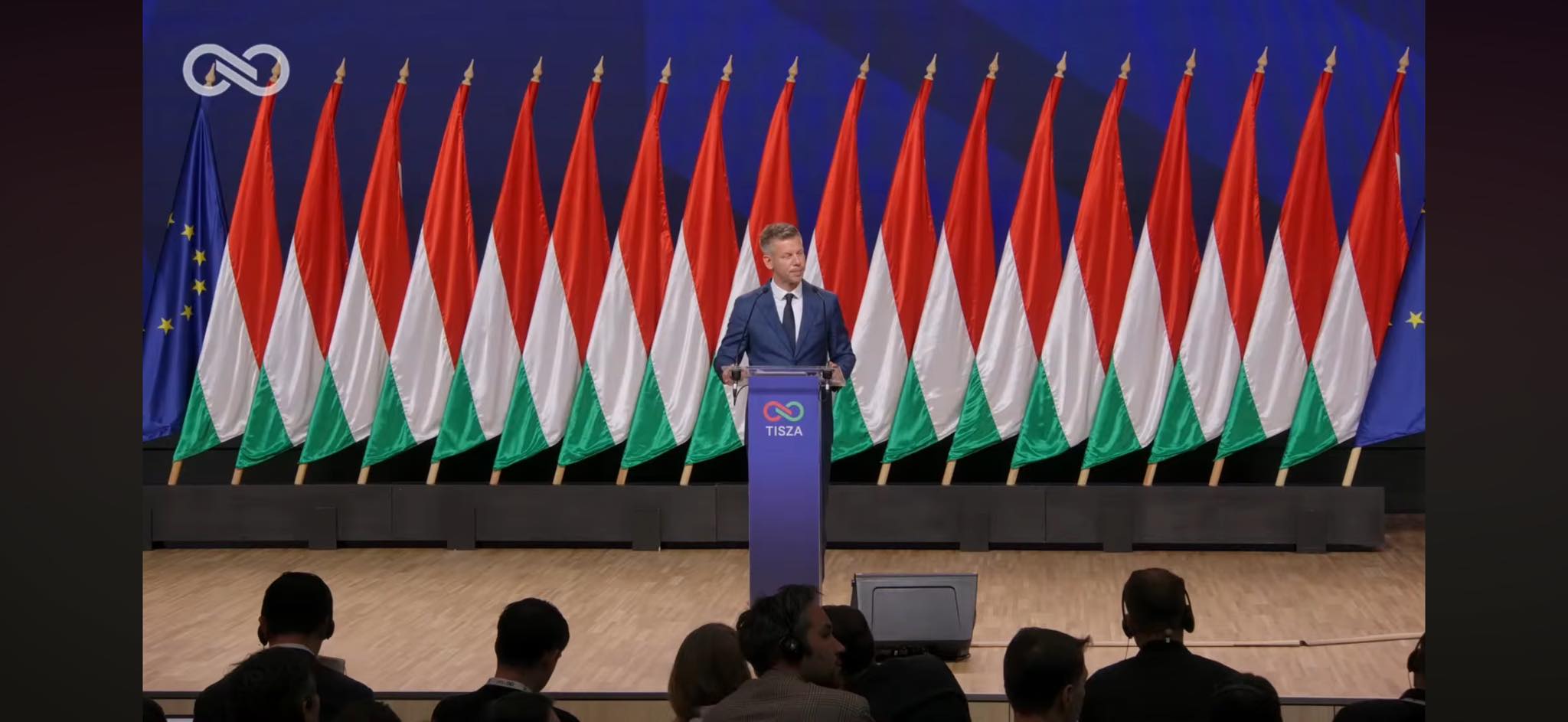
At an international press conference in Budapest following his party’s sweeping election victory, Péter Magyar declared that Hungary had entered a new political era. After the Tisza Party secured a two-thirds parliamentary majority, Magyar described the result not simply as a change of government, but as the beginning of a full-scale democratic transformation.
In his remarks, he framed the election outcome as a historic mandate for “regime change” in the political and institutional sense, with the aim of building a democratic, just, and firmly European Hungary.
Personal Sacrifice and Political Mission
Magyar stressed that his return to politics was not driven by personal ambition, but by a conscious decision to sacrifice the stability of his former life, including his family circumstances, in order to pursue political change. He said he had not stepped forward to create “an Orbán Viktor-lite system,” but to lay the foundations for a fundamentally different kind of state.
According to Magyar, the country now has a chance to move away from centralized power and toward a civic democracy based on justice, pluralism, and institutional balance.
Institutional Reform and Democratic Renewal
A central theme of the press conference was institutional reconstruction. Magyar argued that the election result had given his government a clear democratic mandate to launch far-reaching reforms aimed at restoring the rule of law and rebuilding the separation of powers.
Responding to a journalist’s question about whether a two-thirds majority could be used to replace officeholders appointed under the previous system, he said that where current leaders refuse to resign, democratic legitimacy may require the renewal of those positions. At the same time, he emphasized that any such changes would take place strictly within constitutional and rule-of-law frameworks.
Migration and European Cooperation
On migration, Magyar made clear that he rejects the European Union’s quota system and any mandatory relocation mechanisms. However, he also underlined that Hungary remains committed to European-level cooperation in border protection and law enforcement.
His position suggests a model in which Hungary continues to act within the EU’s institutional framework while resisting compulsory resettlement schemes. At the same time, he voiced support for pragmatic forms of joint European action, including stronger coordination in border control and policing.
A European Future Without Confrontation
Magyar stated that Hungary’s future lies within the European Union, while also insisting on respect for national sovereignty. He argued that the country’s goal should not be permanent confrontation with Brussels, but a return to predictable and constructive participation in common European decision-making.
Addressing foreign policy more broadly, he said that the previous government’s “Eastern Opening” strategy would not be dismantled wholesale. Economic ties with Asian and other non-European partners, he noted, would remain in place as long as investments comply with Hungarian law and generate real economic added value. Still, he stressed that Hungary’s foreign policy, as an EU member state, cannot run counter to Europe’s broader strategic interests.
Poland, the Visegrád Group, and Regional Diplomacy
Regional cooperation was another major pillar of Magyar’s message. He identified the revival of the Visegrád Group as a strategic objective and spoke of restoring relations with Poland, which he called a key state in Central European cooperation.
Under the emerging agenda, Hungary would seek to reestablish itself as an active and reliable player in the political and economic life of the region, while also maintaining pragmatic and stable ties with Austria and other neighboring countries.
Chinese Investment and Economic Pragmatism
In response to a question from a Hong Kong journalist about BYD’s investments in Hungary, Magyar said his government would support all foreign investment that meets regulatory standards and delivers genuine value to the Hungarian economy.
He argued that such projects should be judged not ideologically, but on whether they integrate into the domestic economic structure, strengthen supply chains, and contribute meaningfully to GDP growth.
Democracy, Safeguards, and Self-Restraint
When asked what guarantees there are that Hungary would not simply replace one centralized system with another, Magyar pointed to society itself as the strongest safeguard. He said the Tisza Party’s network of tens of thousands of volunteers represents a civic and political force that would not tolerate the abandonment of democratic norms.
He also suggested that the future government would be deliberately heterogeneous in composition, presenting political diversity within the cabinet as an additional guarantee of pluralism and internal restraint.
Core Principles and a “National Minimum”
Magyar outlined what he called the basic principles of the incoming government: the protection of private property, transparency in the use of public funds, and the defense of children and families. He described these not as partisan goals, but as elements of a broader “national minimum” that should shape the functioning of the state regardless of electoral cycles.
A Reformist and Pro-European Direction
Taken as a whole, the press conference presented the Tisza Party’s governing vision as strongly reformist, pro-European, and institutionally restorative, while remaining economically pragmatic. Its central priorities appear to be the rebuilding of rule-of-law institutions, the normalization of Hungary’s relationship with the European Union, and the revival of regional cooperation, especially within Central Europe.
The core political message was unmistakable: this election is being cast not merely as a transfer of power, but as the beginning of a deeper transformation in Hungary’s political order. In Magyar’s telling, the country now stands at the threshold of a new era—one defined by democratic reconstruction, European reintegration, and a conscious break with the centralized logic of the past
Photo: Facebook/Tisza Párt hivatalos honlapja