
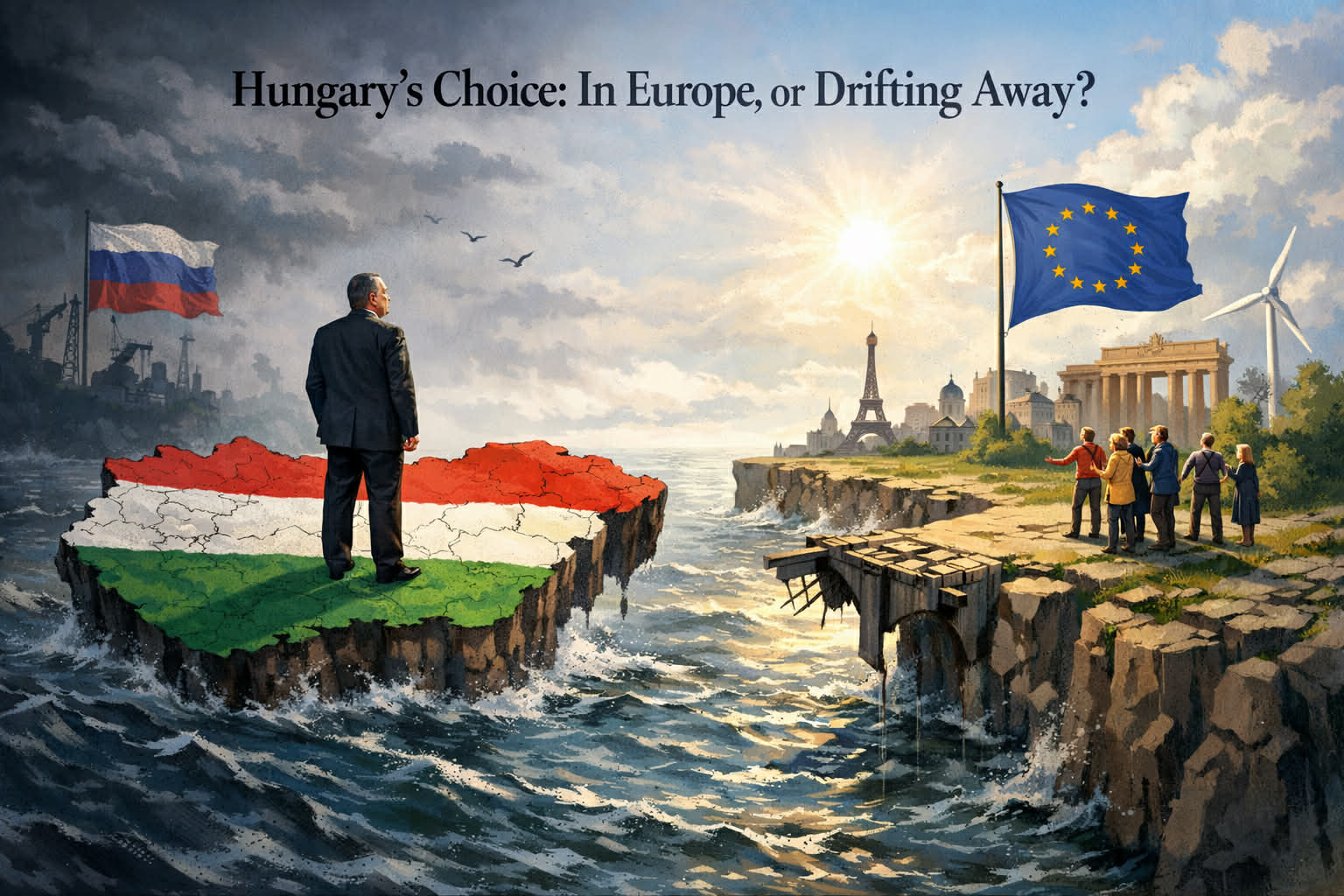
Hungary’s next election is not merely a domestic political contest. Its significance extends well beyond the country’s borders, raising broader questions for Europe as a whole. After 1989, Hungary emerged from communist rule as a democratic state oriented toward the West, eventually joining the European Union. Yet the political trajectory of recent years has increasingly prompted a more fundamental question: to what extent does the country still remain an organic part of that community?
A System Recast Around Power
Over the past decade and a half, Viktor Orbán’s government has built a highly centralized political system that differs in key respects from the institutional model of Western democracies. Across Europe, democratic governance is generally founded on checks and balances, a predictable legal order, economic competition, and relatively equal access to public resources. In Hungary, by contrast, the system has become increasingly shaped by political loyalty and personal networks.
From Rules to Relationships
Critics argue that this model bears closer resemblance to Eastern—often described as “Russian-style”—systems, where power is concentrated and informal patronage networks play a defining role. The autonomy of local governments has narrowed, while access to resources often appears to depend not solely on transparent rules, but also on political connections. Over time, this can weaken competition, legal certainty, and institutional predictability—developments that are also reflected in Hungary’s international standing.
Hungary’s European Fault Line
At the same time, Hungary’s foreign-policy direction has become an increasing source of tension within Europe. Since Russia’s invasion of Ukraine, most European countries have taken a broadly unified position in support of Ukraine. The Hungarian government, however, has diverged from that consensus on several key issues. This increasingly exceptionalist approach poses a challenge to the functioning of the European Union, where unanimity is still required in many important decisions.
The Opposition as European Alternative
The election, therefore, is not only about judging the current government. It is also about the credibility of the alternative. In the programme of Péter Magyar and the Tisza Party, the restoration of the rule of law and democratic institutions features prominently. Their proposals include ending the prolonged state of emergency and rolling back government by decree, introducing term limits for prime ministers, and preparing a new constitution through broad-based social consultation. Reform of the public media, anti-corruption measures, and Hungary’s accession to the European Public Prosecutor’s Office also form part of the platform.
A Different Foreign-Policy Compass
In foreign policy, the Tisza Party has made clear its commitment to closer alignment with the European and broader Western alliance system. According to its position, Hungary should act as an active and predictable partner in the European Union’s collective decision-making, including on policies related to support for Ukraine. At the same time, its approach maintains that the long-term resolution of the war must ultimately be diplomatic, taking Europe’s security interests into account while unequivocally rejecting Russian aggression.
More Than a National Vote
The stakes of this election clearly extend beyond Hungary itself. The question is not simply who will govern the country in the coming years, but what path Hungary will choose: whether it will reaffirm its place within Europe’s political and values-based community, or continue moving in a direction increasingly at odds with it.
Al-generated illustration