
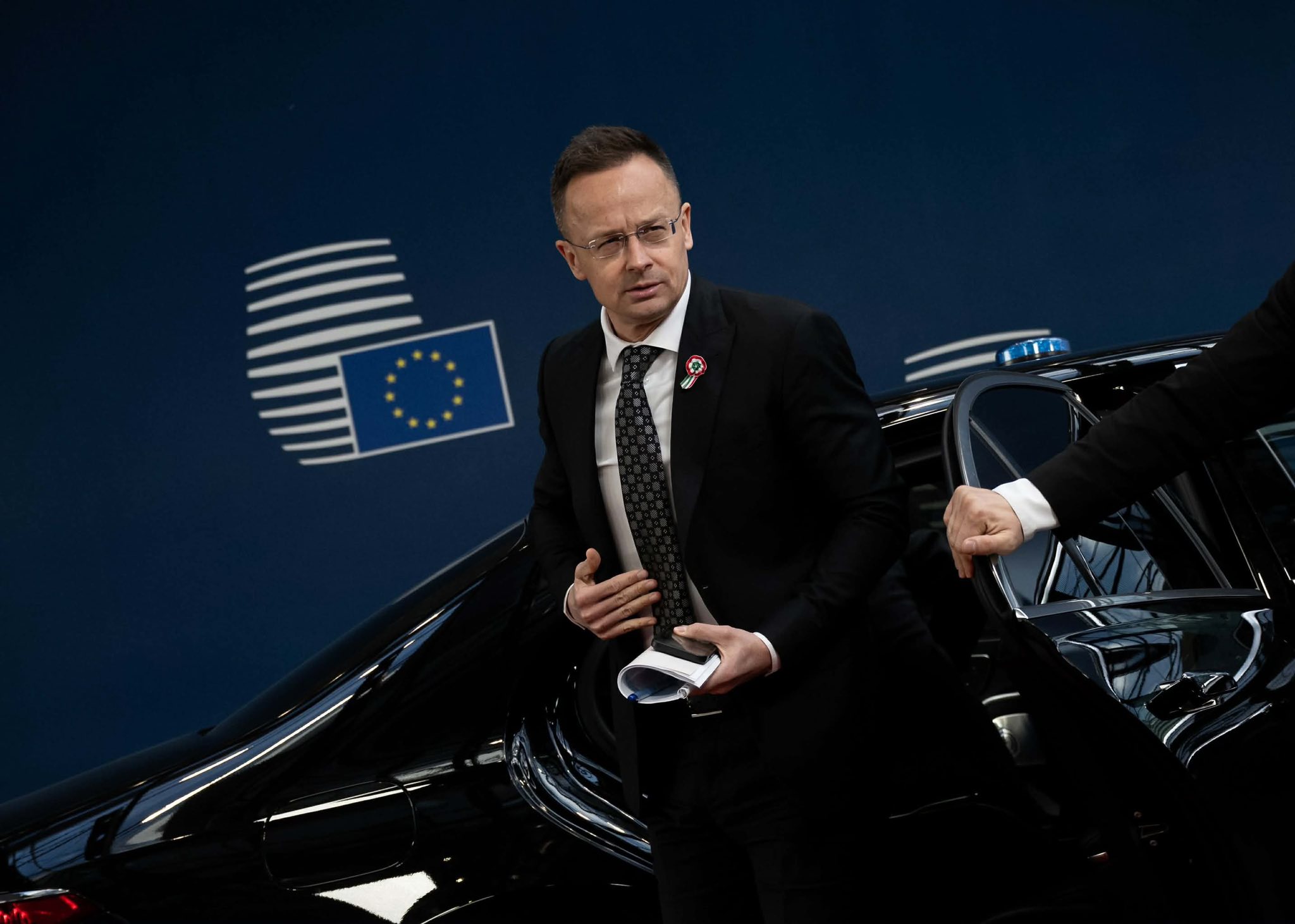
As Hungary moves toward its April 12 election, the campaign is being shaped less by conventional policy debate than by competing security narratives. Two developments have driven that shift: a second leaked recording of a call between Hungary’s foreign minister and his Russian counterpart, and the interview given by a young IT specialist known publicly as “Gundalf.” Different in substance, both stories push the race in the same direction — toward allegations of hidden influence, surveillance and political manipulation.
The leak that went beyond diplomacy
The significance of the second leaked recording lies not in the existence of contact with Moscow, but in what the call appears to show. According to the published transcript and audio reporting, the Russian side raised the case of Alisher Usmanov and sought help in removing his sister, Gulbahor Ismailova, from the EU sanctions list. The Hungarian response indicated openness to assist and referred to a possible joint move with Slovakia. That made the issue more serious than ordinary diplomatic contact: it appeared to show direct discussion of how to ease EU sanctions for a Russia-linked figure.
That is why the leak proved more damaging than earlier reports of regular communication with Moscow. Contact between foreign ministers is not unusual in itself. What changed the meaning of this exchange was that it appeared to concern a concrete sanctions case in which Budapest could influence an EU process. The controversy was not about the existence of a channel, but about how that channel may have been used.
The foreign minister’s public response followed a clear line. He did not deny speaking with Moscow. Instead, he argued that such communication is part of normal diplomacy. He also rejected the suggestion that he was acting on behalf of any oligarch, saying no oligarch had asked him for anything personally. That answer narrowed the issue, but did not remove the central political question raised by the recording.
Hungarian reporting later described further material in which the same minister appeared to discuss broader sanctions questions with Russian officials, including efforts to identify “Hungarian interests” that could be used against parts of EU sanctions packages. Taken together, the recordings suggested an active working channel with Moscow on issues that were simultaneously under debate inside the EU.
The “Gundalf” interview weakened a key domestic narrative
At the same time, a separate domestic story complicated the government’s own security case. In his interview, Dániel Hrabóczki — known publicly as “Gundalf” — said that important parts of what he had earlier told the Constitutional Protection Office were untrue. He did not describe this as confusion or faulty memory. He said he had deliberately fed falsehoods into the questioning because he believed the case around him and other IT specialists linked to the opposition had already been politically framed in advance.
That made the interview more serious than a simple correction. He was not just revising details; he was challenging the reliability of statements already used in public to suggest a wider security threat around the opposition. By his own account, he chose to “take control” by building a narrative of his own inside the interview process.
He also questioned the credibility of the process itself. He said he had been told the interviews were classified, yet parts later surfaced publicly in politically useful form. He further referred to messages from an unknown figure called “Theo,” which he said shaped the way he approached the questioning. Rather than clarifying the case, the interview made it harder to sustain the image of a coherent national-security story. Earlier Hungarian reporting had already shown that the government was building a wider security narrative around the young IT specialist and the Tisza-linked environment, while opposition figures argued that the case was being used politically. The interview did not settle that dispute, but it did weaken one of its central pillars by asserting openly that some of the earlier claims had been deliberately fabricated.
A race increasingly framed by suspicion
Taken together, the two affairs show how sharply the campaign has changed. One is a foreign-policy leak that raises questions about Hungary’s Russia ties and its role inside the EU. The other is a domestic intelligence-linked case in which a key figure has now cast doubt on his own earlier account. The common thread is not that the stories are identical, but that both pull the campaign away from ordinary political competition and into a struggle over trust, loyalty and hidden influence.
That is what gives the final stretch of the race its darker tone. One story casts doubt on Hungary’s external alignment. The other casts doubt on the credibility of a security case used against the opposition. Neither now sits outside the campaign. Both have become part of its core language
Photo:Facebook/ Szijjártó Péter