
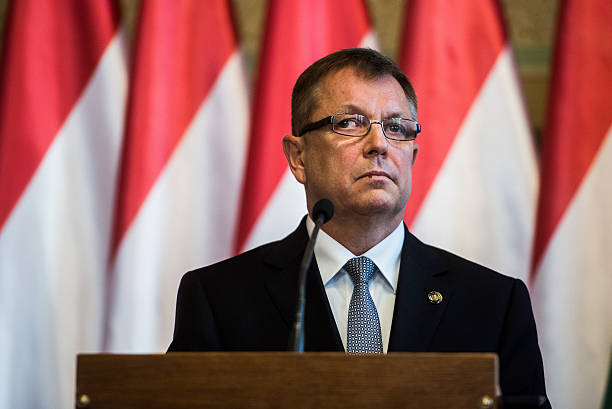
The detention of former central bank governor György Matolcsy marks a major development in an investigation into the management of assets linked to Hungary’s central bank. Beyond the allegations against individual suspects, the case raises broader questions about financial transparency, institutional oversight and the protection of public wealth.
A former central bank governor in custody
Hungary’s former central bank governor György Matolcsy was detained on 21 October 2026 as part of a criminal investigation into suspected financial misconduct connected to the National Bank of Hungary (MNB) and its foundations.
Matolcsy, who led the central bank from 2013 to 2025, was questioned as a suspect on suspicion of economic fraud causing particularly significant financial damage and other offences. His lawyer also identified the suspected use of a forged private document among the allegations. Following several hours of questioning, prosecutors sought Matolcsy’s pre-trial detention. A court decision was still pending on Wednesday evening.
The prosecutor’s office said the operation involved searches at several locations and the seizure of evidence. Two other people were also detained: a representative of a private equity fund involved in the transaction under investigation and a lawyer who participated in the securities deal. Authorities sought international arrest warrants for two additional individuals, identified in public reporting as Matolcsy’s son, Ádám, and businessman György Stofa.
The allegations have not been established in court. Matolcsy’s lawyer said his client had not made a statement during questioning, adding that the defence needed to examine the evidence before responding to the substance of the accusations. The presumption of innocence remains in force.
The transaction at the heart of the investigation
The case is rooted in the management of assets transferred to foundations established by the central bank during Matolcsy’s tenure.
In 2014, the MNB created the Pallas Athéné foundations and transferred more than HUF 266 billion in assets to them, according to the prosecutor’s account. The money came from the central bank’s foreign-exchange gains. The foundations’ assets were managed by Optima Befektetési Zrt. In 2019, the foundations merged to form the PADME Foundation.
Investigators are examining a securities-lending agreement dated 28 February 2025, shortly before Matolcsy’s final day as central bank governor. Prosecutors allege that the agreement was simulated and that its real purpose was to transfer control over the PADME Foundation’s assets to a circle of people who could remain influential after Matolcsy left office.
According to the prosecution, the transaction involved transferring shares in Optima Befektetési Alapkezelő Zrt. to the Central European III Private Equity Fund. The fund manager controlled assets with a market value of close to HUF 200 billion.
Prosecutors allege that the arrangement was intended to enable investments serving the interests of Matolcsy and his son. They say the transaction caused financial damage exceeding the HUF 500 million threshold associated with particularly significant losses, although the precise amount has not yet been established.
These are the prosecution’s allegations, not judicial findings. The investigation must determine the legal nature of the agreement, who was responsible for the relevant decisions and whether the alleged financial damage can be demonstrated.
Why the foundations matter
The controversy surrounding the MNB’s foundations predates the latest arrests. Their investments and financial management had already attracted scrutiny, including from Hungary’s State Audit Office.
The broader issue is how public assets should be supervised when they are transferred to organisations operating under separate legal arrangements. Even where an institution or foundation has a distinct legal status, the origin of its funding and the public purpose for which it was established can make financial oversight a matter of considerable public interest.
The distinction between investment losses and criminal conduct is crucial. A poorly performing investment does not automatically constitute a crime. Criminal liability depends on the evidence, the applicable law and the actions of the people involved.
In this case, prosecutors are investigating a specific alleged transaction and its intended effects. The wider history of the foundations provides context, but it should not be treated as proof of every allegation made in public debate.
Central bank independence is not immunity from scrutiny
Central bank independence is designed to protect monetary policy from short-term political pressure. It helps maintain confidence in decisions concerning interest rates, inflation and financial stability.
But independence does not mean that financial management should be beyond scrutiny. A central bank must operate within the law, maintain effective controls and ensure that assets under its responsibility are handled appropriately.
The Matolcsy case illustrates the difference between independence in monetary policy and accountability for financial decisions. The first protects an institution from improper political interference; the second ensures that public trust is supported by transparent procedures and credible oversight.
The foundations’ structure also raises a wider governance question: how can public institutions ensure that substantial assets remain subject to effective supervision after they have been transferred to separate entities?
The answer depends not only on legal rules but also on the strength of audits, reporting requirements and mechanisms for investigating suspected misconduct.
The political context
Matolcsy was a prominent figure in the economic policies of former prime minister Viktor Orbán’s government. Before becoming central bank governor, he served as economy minister and helped shape the government’s economic approach.
The investigation is unfolding after Hungary’s change of government in 2026, with the new administration placing greater emphasis on investigating suspected financial abuses associated with the previous period. That context makes public confidence in the independence and consistency of law enforcement especially important.
Investigations into people who previously held powerful positions can strengthen trust in public institutions if they are based on evidence and conducted under clear legal standards. They can also become politically divisive if the public perceives them as instruments of political retaliation.
The appropriate test is not whether a case damages one political camp or benefits another. It is whether the authorities can substantiate the allegations and whether the courts assess the evidence independently.
What happens next?
The immediate procedural question is whether a court will order Matolcsy’s pre-trial detention. Beyond that decision, investigators will need to establish the circumstances of the transaction, identify the responsibilities of the individuals involved and determine the extent of any financial damage.
The case may also intensify debate about the supervision of public assets, the role of state audit institutions and the transparency of financial arrangements linked to public bodies.
For international observers, the affair raises a question that extends beyond Hungary: how can governments ensure that public wealth remains accountable when it is managed through complex institutional and financial structures?
The answer will depend on the quality of the evidence, the independence of the legal process and the willingness of institutions to make their decisions open to scrutiny. The Matolcsy case has not yet produced a final judicial conclusion. It has, however, become a significant test of Hungary’s ability to investigate allegations involving a former senior economic official through a transparent and legally sound process.